
The Weeks Before Surgery Are a Medical Event Too
Surgical and Medical Anxiety
If you have surgery scheduled, you are probably discovering something that rarely gets discussed at pre-op appointments: the waiting is its own ordeal. The procedure has a surgeon, an anesthesiologist, and a care team. The three weeks before it have only you, at 2 a.m., rehearsing everything that could go wrong.
Surgical anxiety is not a character flaw, and it is not something you should have to white-knuckle. It is a predictable response to a real event, and it responds to preparation the way most challenges do. That is the premise of a program I offer called The Prepared Mind.
What The Prepared Mind is
The Prepared Mind is a three-session hypnotherapy program for adults preparing for elective surgery or anxiety-provoking medical procedures. In it, you learn self-hypnosis, guided imagery, and relaxation techniques to manage pre-operative anxiety, support comfort through the procedure, and assist your recovery. The program is designed to complement your medical team's care, never to replace it.
I want to be plain about what this program is not, because plainness matters more in medicine than in marketing. I make no promises about your surgical outcome. I do not treat any medical condition. What I offer is preparation: a set of learnable mental skills, taught in a structured way, timed to your procedure.
What the research shows
Hypnosis before surgery is one of the better-studied applications of hypnotherapy, and I would rather show you the studies than adjectives.
In a randomized clinical trial published in the Journal of the National Cancer Institute, 200 breast surgery patients received either a brief hypnosis session before surgery or standard attention. The hypnosis group required less anesthesia and reported less post-surgical pain, nausea, fatigue, and emotional upset (Montgomery et al., 2007).
A meta-analysis of 34 randomized controlled trials covering 2,597 patients found that hypnosis in surgical settings had positive effects on emotional distress, pain, and medication consumption (Tefikow et al., Clinical Psychology Review, 2013). An updated meta-analysis of 50 trials and 4,269 patients confirmed those findings (Holler et al., Clinical Psychology Review, 2021).
These studies describe what researchers observed in groups of patients. They are not a prediction about you. I include them because you deserve to know that this approach rests on evidence, not enthusiasm.
How the program works
The program consists of three private sessions, scheduled around your surgical date.
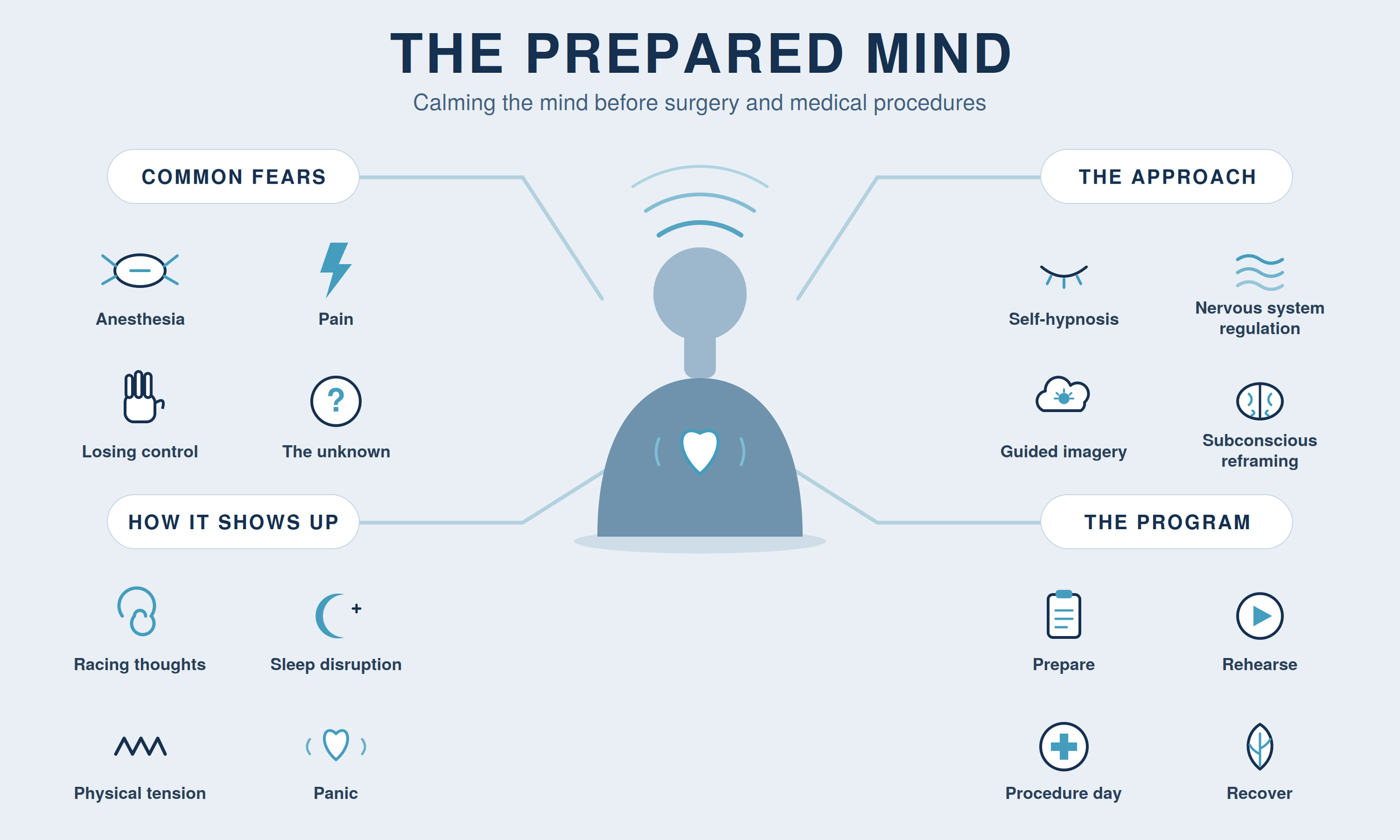
Session one: assessment and skills. We begin with your specific concerns: anesthesia, pain, loss of control, the recovery ahead. Then I teach you self-hypnosis, a skill you practice on your own from day one.
Session two: rehearsing the day. Using guided imagery, we walk through your procedure day from arrival to waking, so that when the day comes, part of your mind has already been there and found it manageable.
Session three: recovery. After your procedure, we reinforce the skills for comfort, sleep, and following your recovery plan.
Between and after sessions, you receive dedicated audio recordings for daily practice. These recordings help condition and program your mind for a more favorable experience.
Questions I hear most often
Does my surgeon need to approve this? No approval is needed, but I encourage every participant to inform their surgical team, and a summary of your participation is available to your care team at your request. In my experience, physicians respond well to patients who arrive prepared.
Is hypnosis safe before surgery? The sessions involve no medication and nothing physical; you remain aware and in control throughout. What you learn is a focused, practiced form of attention.
I am not having surgery, but medical settings frighten me. Is this for me? Yes. The same skills apply to MRI claustrophobia, needle fear, and other procedure-related anxiety. The structure adapts to the situation.
When should I start? Ideally two to four weeks before your procedure, which allows time for practice. Shorter timelines can be accommodated.
The waiting can be spent differently
Most people spend the weeks before surgery bracing. Bracing is exhausting, and it hands those weeks over to fear. Preparation gives them back. If your procedure is on the calendar and you would like to arrive at it steady, I would be glad to help.
The Prepared Mind is offered both online and in-person. To ask a question or schedule a first session, call 617-564-0707 or click the button below.